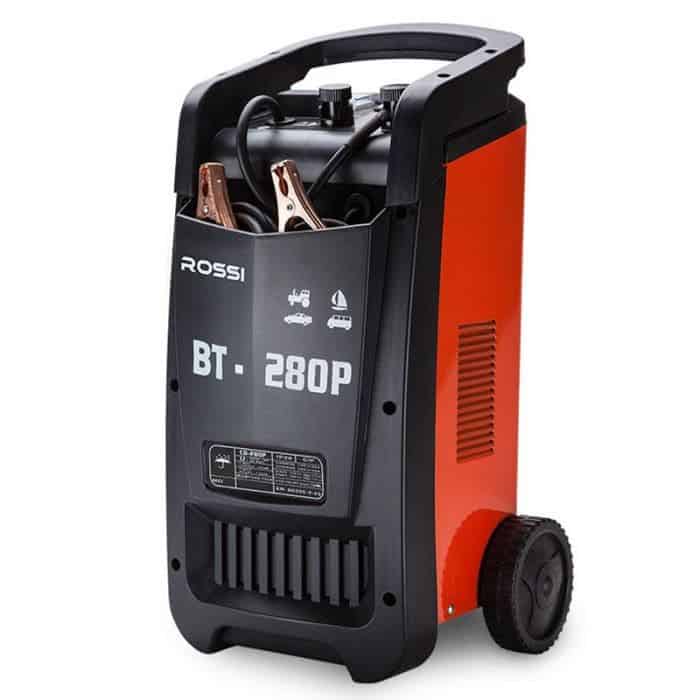
In brief: The ROSSI 280P may suit shed and workshop buyers needing lead-acid charging and starting assistance, provided they have suitable 15A mains power and confirm battery compatibility.
The ROSSI 280P is worth considering if you need a mains-powered battery charger with starting assistance for 12V and 24V systems. Its appeal is straightforward: the merchant lists up to 50A continuous charging and 280A starting output in one unit.
Those figures do not make it a universal charger or a guaranteed way to start every vehicle. The important questions are whether your batteries can accept its charging settings, whether your vehicle permits this type of starting assistance, and whether you have the required 15A power outlet.
This guide explains what the supplied listing establishes, what remains unclear and what to check before ordering.
What the supplied listing actually tells us
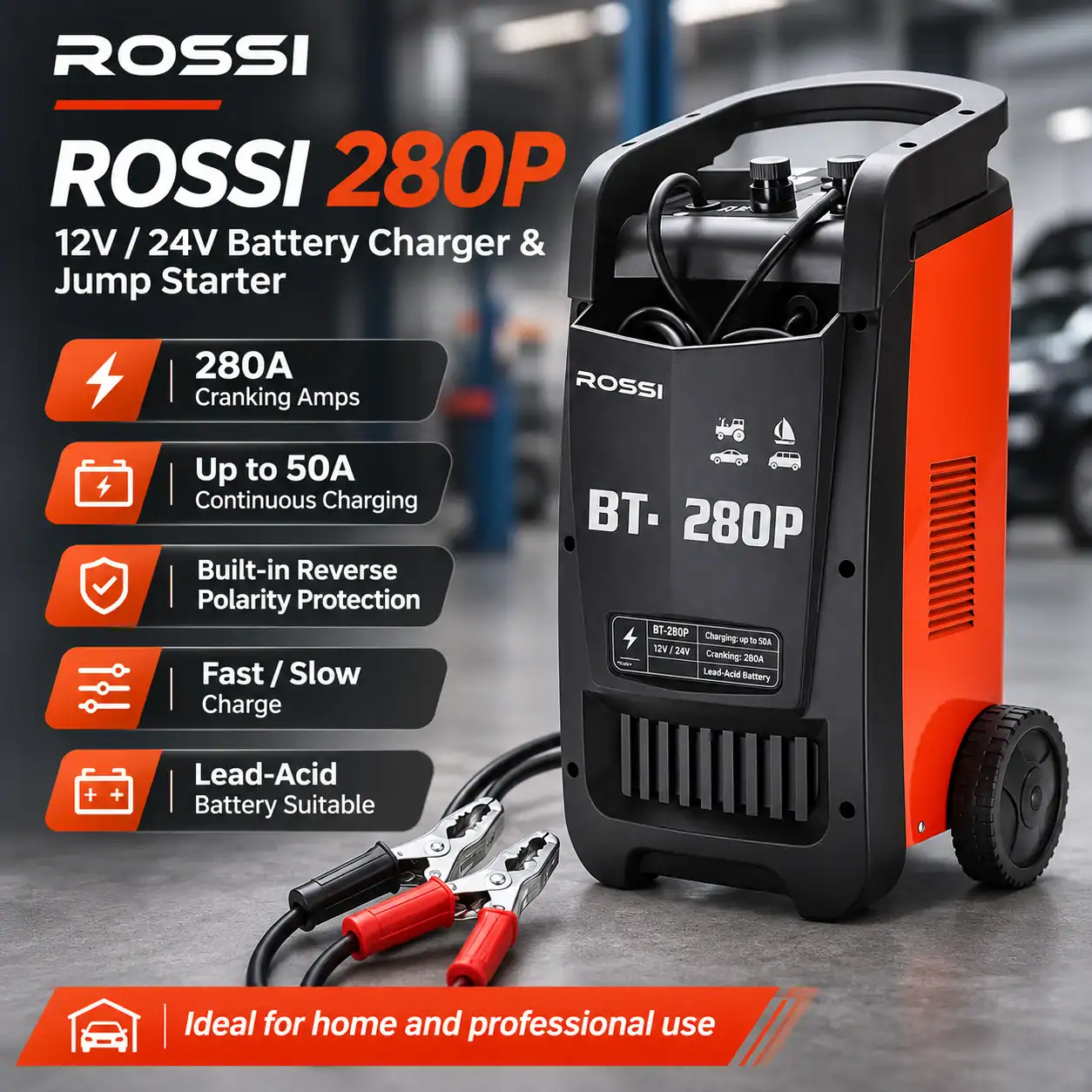
The merchant identifies this model as the ROSSI 280P, with SKU ATOCHG280ROSACAB. It describes a single-phase charger for lead-acid batteries, with both charging and jump-start functions.
- Battery system voltages: 12V and 24V.
- Advertised starting output: 280A, described by the merchant as cranking amps.
- Advertised charging output: up to 50A continuous.
- Controls and display: fast/slow charging settings and an ammeter.
- Listed protection: accidental reverse-polarity protection.
- Power connection: a 15A plug is specified in the product title.
The supplied information does not establish the output available at each voltage, the slow-charge current, supported battery capacities or the starting duty cycle. Those are important omissions, particularly if you want to charge small batteries or use the starting function repeatedly.
ATVs, boats, trucks and tractors appear in the product title. Treat these as suggested applications, not proof that every battery or vehicle in those categories is compatible.
Check your power supply before anything else
The 15A plug requirement could be the deciding factor. A standard Australian 10A household socket is not a suitable connection for a 15A plug. Check the outlet where you intend to use the charger, rather than assuming any garage power point will work.
Do not modify the plug or use an adaptor to bypass the supply requirement. If a suitable outlet is not available, ask a licensed electrician about an appropriate installation and include that cost in your buying decision.
This is a mains-powered charging and starting unit, not a self-contained jump pack. It therefore suits a powered shed or workshop more naturally than a roadside emergency kit or an unpowered campsite.
Before buying, also check:
- The charger’s dimensions and weight against your storage space and ability to move it.
- The supplied mains lead and charging lead lengths.
- The distance from a suitable outlet to your vehicle’s approved charging points.
- Any extension-lead restrictions in the manual.
- Whether you can position the unit in a dry, ventilated location as instructed.
Battery compatibility matters more than the headline amps
The listing says lead-acid, but that is a broad category. Flooded, AGM, gel and other lead-acid battery designs can have different charging requirements. The supplied information does not confirm which of these the ROSSI supports.
Check the battery manufacturer’s recommended charging voltage and maximum current against the charger’s documented settings. A high maximum output can be useful for some larger batteries, but it is not automatically suitable for a small ATV or motorcycle battery.
The fast/slow selector does not resolve this question by itself. You need the actual current range and charging behaviour, not just the setting names. Do not assume a battery will safely regulate an unsuitable charger.
- For AGM or gel batteries: obtain explicit compatibility information before buying.
- For lithium batteries: compatibility is not established. Do not use it without explicit approval for the exact battery chemistry and model.
- For 24V systems: confirm the battery-bank arrangement and approved connection points in the vehicle or equipment manual.
- For damaged or deeply discharged batteries: do not assume high charging current will restore them.
Confirm the system voltage from the equipment documentation. A truck, boat or tractor label alone is not enough.
What 280A starting and 50A charging mean in practice
Starting assistance and battery charging are different jobs. The advertised 280A figure relates to the starting function; it is not a continuous charging rating or a battery capacity figure.
It should not be treated as directly equivalent to a battery’s cold-cranking amps rating. The supplied listing gives no test conditions for that comparison. Whether the unit can help start a particular engine depends on factors including battery condition, temperature, engine requirements and the allowed cranking duration.
Before using this function, confirm the permitted cranking time, required rest period between attempts and compatibility with the vehicle’s electronics. Repeated attempts without observing the manual’s limits can overheat equipment.
The advertised 50A continuous charging output is also a maximum, not a promise that every battery will receive 50A throughout charging. Ask whether that output applies at both 12V and 24V, and what conditions or limits apply.
The ammeter provides charging-current information. It does not, on its own, establish battery health or an accurate percentage charged. Automatic shut-off, float charging and a dedicated maintenance mode are not confirmed in the supplied material.
Charging time: avoid relying on a single estimate
The merchant supplies a charging-time example, but there is not enough detail to use it as a reliable planning figure. Battery capacity alone does not tell you how much charge needs replacing.
A rough starting point is the amp-hours to replace divided by the average charging current. Actual time will be longer because charging is not perfectly efficient and current may reduce as the battery approaches full charge.
For example, replacing roughly 50Ah at an average 10A gives a five-hour theoretical baseline, before losses and the finishing stage. This is a general illustration, not a prediction for the ROSSI.
Do not use the maximum advertised current to calculate charging time unless that current is both safe for your battery and realistically maintained. Follow the battery and charger instructions for completion checks; do not assume this model can be left connected indefinitely.
Who this charger may suit—and who should pause
The strongest case for the ROSSI 280P is a powered workshop that handles compatible lead-acid batteries across both 12V and 24V equipment. Combining charging and starting assistance may be useful if both functions match your actual needs.
- Potentially suitable: owners of larger compatible batteries who have a suitable 15A supply and are comfortable checking charging requirements.
- Needs closer checking: mixed fleets with small batteries, AGM batteries or vehicles with specific charging procedures.
- Less suitable: buyers wanting a portable roadside jump pack, confirmed lithium charging or documented unattended maintenance charging.
The main trade-off is that the headline output comes with compatibility and power-supply questions. If you only need occasional charging of one modest-sized battery, a large maximum current may offer little practical benefit.
Compare the total setup cost, not just the charger price. Any electrical work and required accessories matter. Check the listing for current pricing, availability, included items, warranty terms and return conditions before ordering.
Safe use and ongoing care
Lead-acid batteries can release explosive gas and contain corrosive electrolyte. Follow the charger, battery and vehicle manuals, including their ventilation, personal protection and connection requirements.
- Keep sparks, cigarettes and flames away from charging batteries.
- Do not charge a frozen, leaking, swollen or visibly damaged battery.
- Use the approved connection points and connection sequence for the vehicle.
- Inspect leads, insulation and clamps before use; stop using damaged equipment.
- Keep the charger dry and its ventilation openings clear.
Reverse-polarity protection is a useful listed feature, but it is not permission to connect carelessly or evidence of comprehensive fault protection. If you are unsure about a battery’s condition or the correct connection procedure, seek help from a battery specialist or qualified technician.
FAQs before you buy
Can I leave it connected to maintain a battery?
That is not established. The merchant mentions battery maintenance, but the supplied specifications do not confirm automatic float charging or indefinite connection. Check the manual for explicit instructions.
Will it start a diesel truck or tractor?
The listing names trucks and tractors, but it does not establish suitability for a particular engine. Confirm the system voltage, starting requirements, vehicle restrictions and charger’s starting duty cycle.
Can I use it on a small ATV battery?
Only if the battery chemistry, capacity and permitted charging current match a documented charger setting. The ATV reference in the title does not prove the slow setting is low enough.
Does a 24V system need special checking?
Yes. Confirm the bank configuration and approved charging procedure. Do not select 24V merely because more than one battery is fitted.
Evidence limits and buying verdict
This guide is based on the supplied merchant listing, not hands-on testing or independent performance measurements. No manual, detailed output chart or starting-duty information was supplied. The listed output and protection claims have not been independently verified.
The ROSSI 280P may be a practical workshop option, but buy on confirmed compatibility rather than the 280A headline. The key checks are a suitable 15A supply, documented charging settings for your batteries and a starting procedure approved for your equipment. If those details remain unclear, ask for the manual before committing.
Product-information source: Edisons product listing. This article is AI-assisted and requires editorial review. It is not a claim of hands-on testing.