Affiliate disclosure
This buying guide contains affiliate links. Ballarat Search may earn a commission if you buy through them, at no extra cost to you. Product specifications come from merchant information unless otherwise stated. We do not claim hands-on testing.
Ballarat Search · Buying guide
Is GECKO 160L Upright Portable Fridge / Freezer, 12V/24V for Motorhome, Tiny Home, Off-grid and Caravan, Black right for your needs?
In brief: The GECKO 160L upright fridge/freezer may suit caravan, motorhome and off-grid buyers who want substantial freezer space and have a suitable DC power supply and installation area.
Product at a glance
Listed merchant details only — confirm on the current product page before ordering.
Quick buying verdict
The GECKO 160L upright fridge/freezer may suit caravan, motorhome and off-grid buyers who want substantial freezer space and have a suitable DC power supply and installation area. Check the live product specifications and the limitations below before deciding.
View the product at Edisons
Confirm the current specifications, price, availability, shipping and warranty with the retailer.
Affiliate link · Opens in a new tab
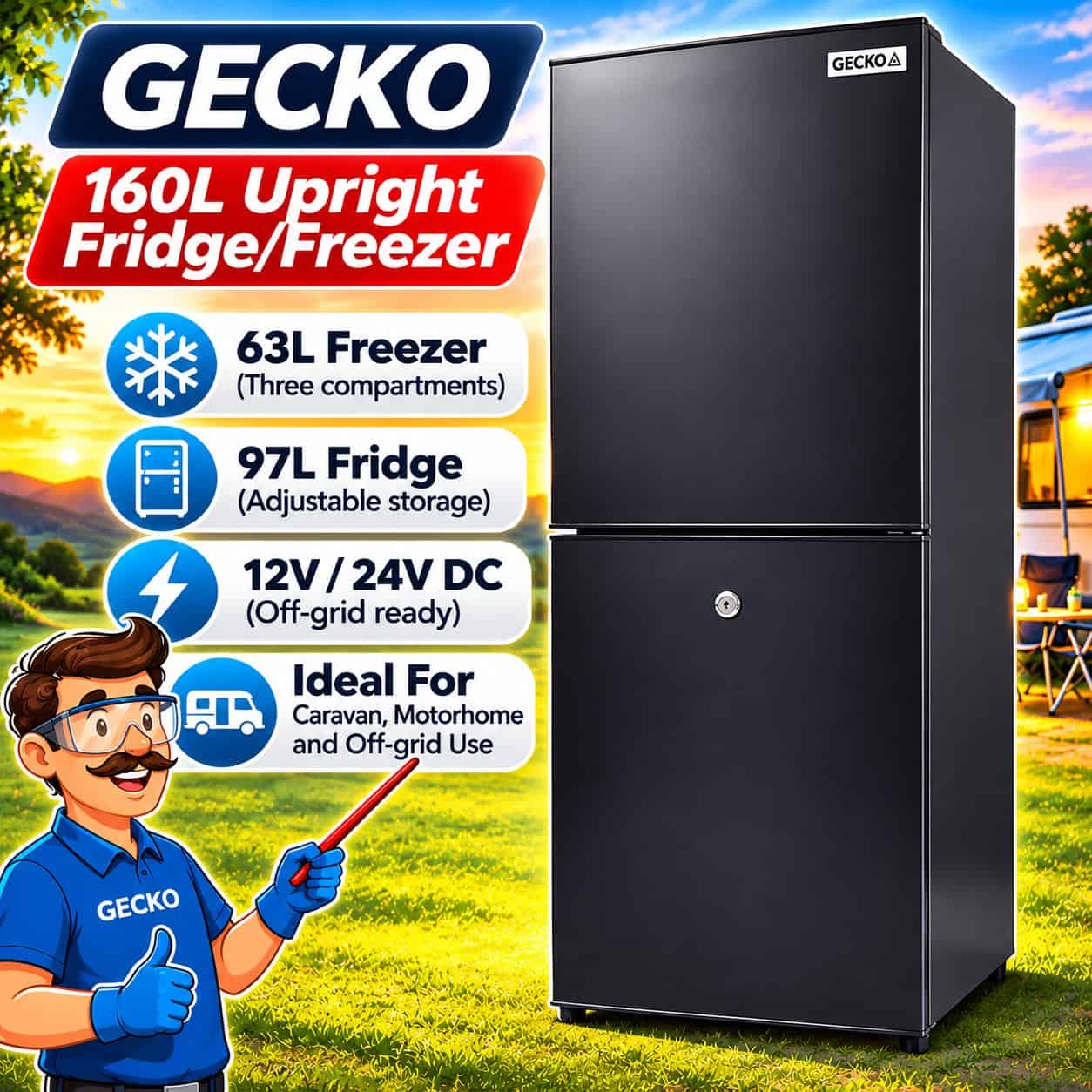
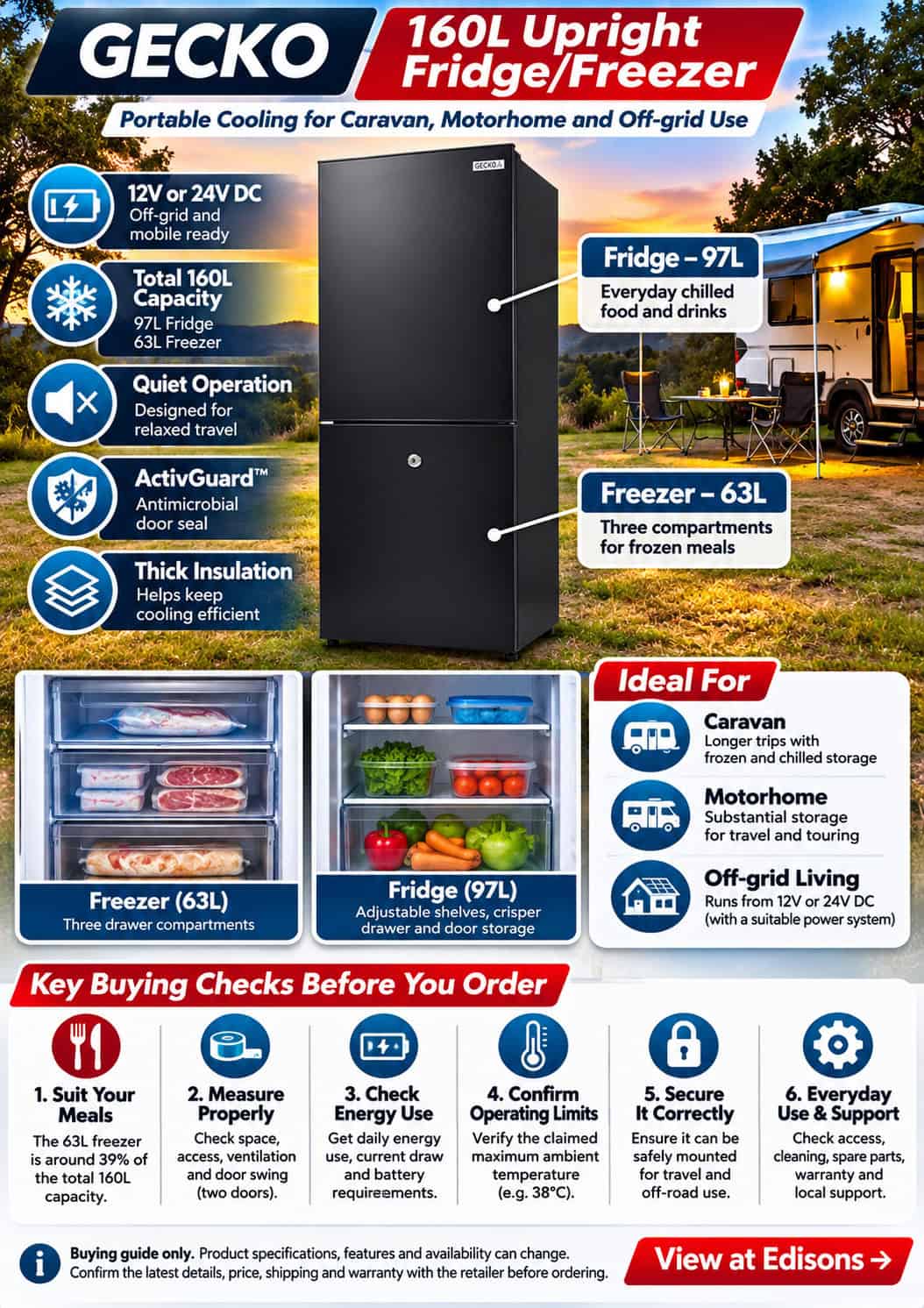
The GECKO 160L upright fridge/freezer has a clear appeal for longer stays away: separate chilled and frozen storage in an upright cabinet, running from 12V or 24V DC power. Its most important detail is the capacity split: a 63L freezer above a 97L fridge.
That makes it worth considering if you carry plenty of frozen meals. But capacity alone cannot tell you whether it will fit your caravan, suit your food habits or work with your battery system. The supplied merchant information leaves several important installation and electrical questions unanswered.
This is a buying guide based on that information, not a hands-on review. Here are the six checks that matter most before ordering.
BUYING CHECK 01
1. Decide whether the fridge/freezer split suits your meals
The freezer accounts for roughly 39% of the stated 160L capacity. That is a substantial share, so think about what you actually pack rather than choosing by total litres alone.
The merchant describes three freezer compartments. In the refrigerator, it lists adjustable steel wire shelves, a large crisper drawer, bottle and condiment shelves, and an egg holder. These are useful organisational features, although internal dimensions are not supplied.
- Potentially suitable: longer trips with frozen meals, meat portions and other foods you plan to thaw gradually.
- Potentially less suitable: households that mainly need chilled drinks, bulky fresh produce or large platters.
- Worth checking: whether your usual containers fit inside individual freezer compartments and between fridge shelves.
Ask for usable compartment measurements if you rely on particular meal-prep containers. Adjustable shelves offer flexibility, but they do not guarantee enough width or depth for a large item.
BUYING CHECK 02
2. Measure the installation space and the path into it
The supplied information does not state external dimensions or weight. Those are essential checks for a 160L upright appliance, especially if it must pass through a caravan doorway or fit an existing cabinet opening.
Measure the space available, but do not assume the fridge can fill it edge to edge. Obtain the installation manual and allow the ventilation clearances it specifies. A cabinet that physically fits may still be unsuitable if heat cannot escape.
- Measure the opening’s height, width and depth.
- Measure the narrowest doorway, corridor and turn along the delivery path.
- Allow for the power connection and required ventilation space.
- Check door swing and room to remove drawers or adjust shelves.
- Confirm the appliance weight and its effect on vehicle payload and weight distribution.
The recessed handles may help keep the front profile tidy. They do not establish how far the door must open for full access. Door reversibility, hinge details and mounting arrangements are not supplied, so check the listing or ask the seller before planning cabinetry.
BUYING CHECK 03
3. Get energy-use figures before sizing your battery system
The merchant states that this model runs on 12V and 24V DC and includes a DC power cable. That describes supply compatibility, not daily electricity consumption or battery runtime.
No measured daily energy use, current draw or compressor duty-cycle information is supplied. Claims about efficient cooling and thick moulded insulation are not enough to calculate how long it will run from your batteries.
Before buying, request:
- Daily energy consumption in watt-hours, including the ambient temperature and temperature settings used for the measurement.
- Rated current and any start-up requirements.
- Recommended cable size, maximum cable run, connector and fuse requirements.
- Details of any low-voltage battery protection and its settings.
For a rough planning method, divide usable battery energy in watt-hours by the fridge’s daily watt-hour consumption. Then allow for other loads, losses and a reserve. Without a credible consumption figure, a runtime estimate would be guesswork.
Mains operation is not established by the supplied information. If you want to plug into a powered campsite or household socket, confirm whether an approved compatible AC-to-DC supply is available and whether it is included. Have fixed wiring installed by an appropriately qualified installer.
BUYING CHECK 04
4. Treat the 38°C ambient claim as a limit to investigate
The merchant claims reliable operation in ambient temperatures up to 38 degrees Celsius. This is a surrounding-air temperature claim, not a stated fridge or freezer temperature range. It also does not prove performance in a poorly ventilated cabinet or a vehicle sitting in the sun.
The supplied information does not include temperature-control ranges, independent test results or the conditions behind that claim. Ask for those details if you travel in hot regions or expect to leave the fridge operating in a parked vehicle.
As general food-safety guidance, aim to keep refrigerated food at 5°C or colder and frozen food at about −18°C or colder. Use a separate appliance thermometer to check actual temperatures; a control setting alone does not confirm safe storage.
The listing’s reference to fast temperature recovery is also unquantified. Pre-chill food where practical, avoid blocking internal airflow and follow the manual’s loading instructions. These habits help refrigeration generally, but they do not extend the appliance’s stated operating limits.
BUYING CHECK 05
Check the details before buying
Confirm the current specifications, price, availability, shipping and warranty with the retailer.
Affiliate link · Opens in a new tab
5. Confirm it can be secured for your intended use
The merchant markets the fridge for caravans, motorhomes, camper trailers, marine use, off-grid cabins and tiny homes. Those suggested uses do not, by themselves, establish a safe installation method for every setting.
For travel, ask whether the appliance has approved mounting points or requires a separate restraint system. Confirm how its doors stay shut in transit and what operating-angle limits apply. None of these details is provided in the supplied description.
Marine buyers should also confirm moisture exposure limits, corrosion suitability and installation requirements. Do not assume that a broad reference to marine use means the appliance can sit exposed to spray or weather.
Although the product is described as portable, its weight and lifting instructions are unavailable. Treat that wording cautiously: confirm the handling requirements before assuming it can be moved regularly between a vehicle and campsite. Follow the manufacturer’s transport and settling instructions before switching it on after a move.
BUYING CHECK 06
6. Check everyday access, cleaning and support
An upright layout can make food easier to organise and reach without rummaging through a deep compartment. The trade-off is that you need clear space in front of the door, which can matter in a narrow caravan aisle.
The merchant describes quiet operation, but supplies no decibel rating or measurement conditions. If the fridge will sit beside a bed, ask for documented noise information rather than treating that description as a guarantee.
GECKO’s ActivSeal is described as an antimicrobial door-seal coating designed to help inhibit bacterial growth. That is a merchant claim about the seal, not proof that food is protected from contamination. Normal cleaning, spill removal and safe storage are still necessary.
Also check the defrost method, drainage arrangements, cleaning instructions and availability of replacement seals, shelves and drawers. Warranty terms and service arrangements are not included in the supplied material. Confirm these before purchase, particularly if returning a large appliance from a remote location would be difficult.
Frequently asked questions
Can it run from a normal household power point?
The supplied description confirms 12V and 24V DC operation only. Check whether a suitable approved mains power supply is supported and whether you need to buy it separately.
Can both compartments be used as a fridge?
The merchant describes a 63L freezer and a 97L refrigerator. It does not establish convertible compartments or independent temperature controls. Do not assume either feature is available.
How long will it run from a battery?
There is not enough information to give a reliable runtime. You need usable battery capacity, measured fridge consumption under relevant conditions, and the power demands of your other equipment.
Is it suitable for an off-grid tiny home?
It may be, provided the storage split suits your household and you can meet its electrical, ventilation and installation requirements. Check energy consumption against your system’s capacity during low-solar periods, not just on a sunny day.
Evidence and limitations
This guide uses the supplied merchant description and product data for GECKO model CMPFRUGK16KA. We have not tested the appliance or independently verified its capacity, cooling, energy efficiency, noise or antimicrobial claims.
Important missing details include dimensions, weight, measured power consumption, temperature ranges, installation clearances and restraint requirements. These gaps prevent a confident judgement about fit or off-grid runtime. Check the current listing and manual before purchase; pricing and availability can change.
Final pre-purchase checklist
- Food storage: the 97L fridge and 63L freezer suit your usual meals and containers.
- Fit: dimensions, door swing, access route and ventilation clearances are confirmed.
- Power: daily consumption, wiring requirements and any mains adaptor needs are understood.
- Conditions: expected ambient temperatures fall within the manufacturer’s documented limits.
- Travel: weight, restraints, door security and operating-angle requirements are acceptable.
- Ownership: cleaning, defrosting, spare parts, warranty and service arrangements are clear.
Bottom line: this model is worth investigating if you want an upright DC fridge with substantial separate freezer storage. If chilled space is your priority, or you cannot obtain the missing fit and power details, pause before committing.
Source: Edisons merchant listing. AI-assisted draft for editorial review. No independent hands-on testing is claimed.