Affiliate disclosure
This buying guide contains affiliate links. Ballarat Search may earn a commission if you buy through them, at no extra cost to you. Product specifications come from merchant information unless otherwise stated. We do not claim hands-on testing.
Ballarat Search · Buying guide
Is BAUMR-AG DP15 600W 10″ Pedestal Bench Drill Press, 12 Speeds, 16mm Chuck (DP15 II) right for your needs?
In brief: The Baumr-AG DP15 II may suit home workshop users wanting a bench-mounted drill press, provided its reach, speed range and mounting requirements match their projects.
Product at a glance
Listed merchant details only — confirm on the current product page before ordering.
Quick buying verdict
The Baumr-AG DP15 II may suit home workshop users wanting a bench-mounted drill press, provided its reach, speed range and mounting requirements match their projects. Check the live product specifications and the limitations below before deciding.
View the product at Edisons
Confirm the current specifications, price, availability, shipping and warranty with the retailer.
Affiliate link · Opens in a new tab
A bench drill press can make it easier to position holes and control drilling depth than working freehand. But choosing one means looking beyond motor wattage and chuck size: the workpiece must fit, the available speeds must suit the bit, and the machine needs a secure place to live.
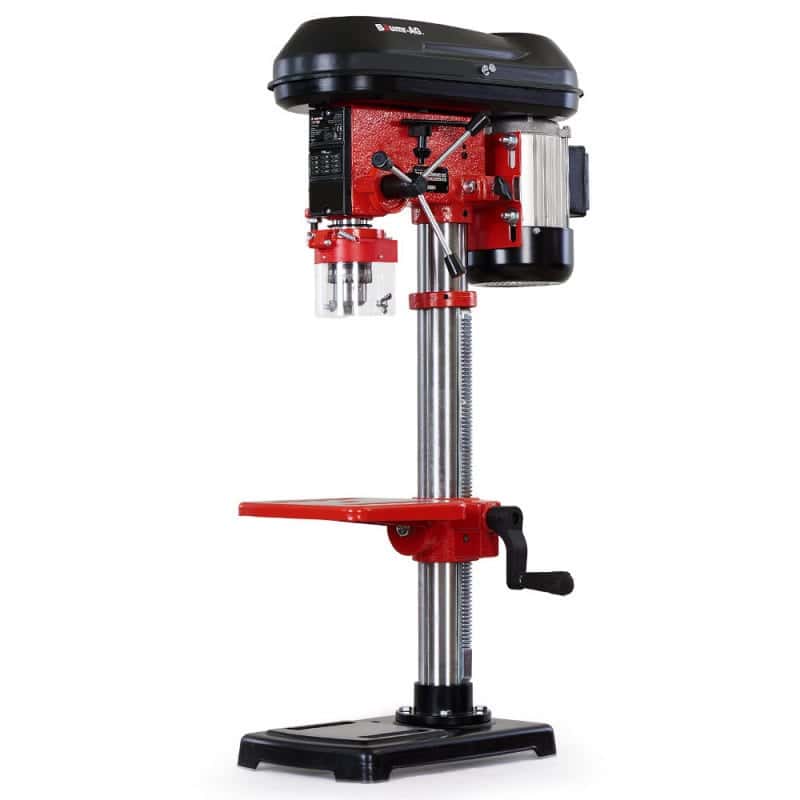
The Baumr-AG DP15 Series II is described by the merchant as a bench-mounted drill press with a 600W brushless motor, 12 speed settings, a 16mm chuck and 60mm of spindle travel. Its adjustable cast iron table and listed switching features are worth considering, but several important dimensions and operating details are missing from the supplied information.
This guide explains what those features mean for a buyer and what to confirm before ordering. It is based on the supplied merchant information, not hands-on testing.
BUYING CHECK 01
1. Check whether your workpieces will fit
The 16mm chuck is a bit-holding specification, not a promise that this drill can make 16mm holes in every material. Drilling capacity depends on the material, bit type, speed, workholding and the machine’s rated limits. The supplied information does not give separate drilling capacities for timber, steel or other materials.
The product name includes a 10-inch designation, but the supplied description does not explain it. Drill presses commonly use a swing measurement, which is different from the distance between the drill centre and column. Confirm the actual throat depth rather than assuming a 10-inch-wide workpiece will fit in any position.
- Measure hole reach: how far is the intended hole centre from the nearest accessible edge?
- Measure workpiece height: allow for the material, drill bit, vice or clamps, and any backing board.
- Check clearances: ask for maximum chuck-to-table and chuck-to-base distances.
- Check chuck range: the minimum bit-shank size is not supplied, which matters for small drill bits.
A simple sketch of your largest likely job is more useful here than choosing by chuck size alone.
BUYING CHECK 02
2. Confirm the speed range, not just the number of speeds
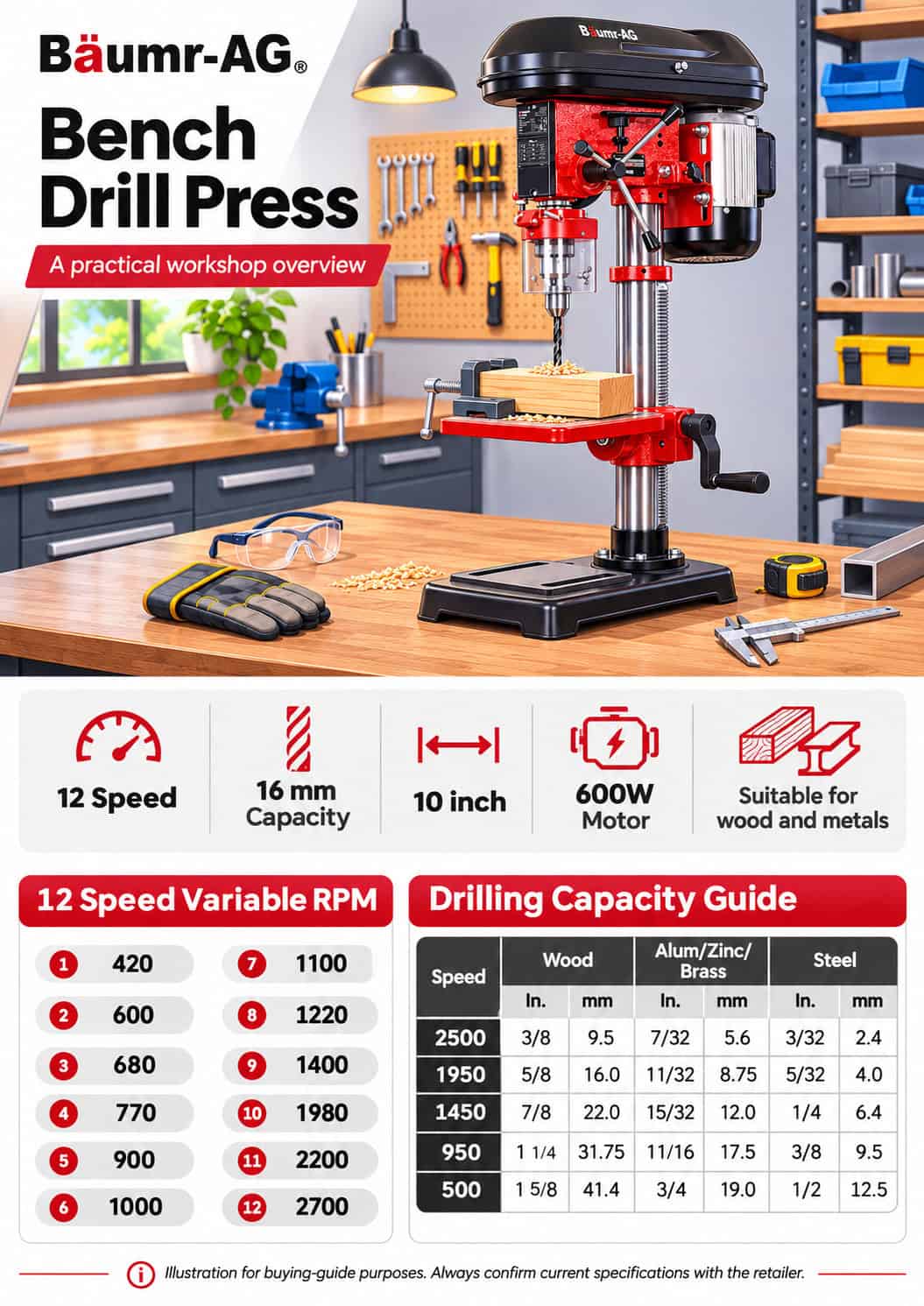
The merchant lists 12 speed settings and a 600W brushless motor. However, it does not supply the minimum and maximum spindle speeds, the individual RPM steps or the method used to change speeds.
Although the description uses the phrase “variable RPM settings”, do not assume this means continuously adjustable speed from a dial. Check the listing or manual for the adjustment mechanism and operating procedure.
Speed matters because a small drill bit and a large cutter may need very different settings. Material also changes the requirements. Ask for the speed chart, then compare it with the recommendations for your intended bits and materials.
The stated motor wattage alone cannot establish low-speed torque, sustained workload capability or drilling accuracy. The merchant’s brushless-motor description also does not provide independent evidence of service life. If regular metal drilling is your main task, confirm the rated capacities and operating limits before buying.
BUYING CHECK 03
3. Match the spindle travel and table to your jobs
The listed 60mm drill travel describes the spindle’s available movement. It does not guarantee a clean 60mm-deep hole in every setup: usable depth also depends on the bit, chuck clearance, workpiece and chip removal.
For repeated-depth work, confirm how the depth adjustment works. The description mentions depth-adjustable travel but does not explain the stop mechanism, graduations or repeatability. Those details matter if you want a row of equally deep blind holes rather than occasional through-holes.
The merchant describes a cast iron work table that tilts up to 45° in either direction. That could be useful for angled holes, but the listing does not establish how accurately the angle scale reads or how securely the table holds an angle under load.
- Check the table dimensions and available clamping points.
- Allow room for your vice without losing too much drilling clearance.
- Confirm how table height is adjusted and locked.
- Check the setup against a suitable square when returning to perpendicular drilling.
For long or awkward pieces, plan separate support rather than expecting the drill table to carry the whole load.
BUYING CHECK 04
4. Plan the bench mounting before it arrives
Despite the word “pedestal” in the product name, the description identifies this as a bench-mounted unit. Treat it as a machine that needs a suitable installation, not something to place loosely on a portable table.
The supplied information does not include overall dimensions, machine weight, base size or mounting-hole spacing. Those omissions prevent a confident judgement about whether it will fit a particular workbench or be convenient to move.
Before ordering, measure:
- Bench space: allow for the base, feed-handle movement and access to controls.
- Overhead clearance: include any access needed for speed adjustment and maintenance.
- Working height: make sure you can see the drilling point without adopting an awkward posture.
- Support area: leave room for longer stock without blocking walkways.
Follow the manual’s mounting requirements and check that the bench can support the installed machine and intended work. A light or unstable bench can undermine an otherwise useful drill setup.
BUYING CHECK 05
Check the details before buying
Confirm the current specifications, price, availability, shipping and warranty with the retailer.
Affiliate link · Opens in a new tab
5. Look beyond the listed safety features
The merchant lists an extendable chuck guard, an emergency shut-off button and dust-protected NVR switches. It says the NVR arrangement prevents a restart when power returns after an outage. These are useful features to investigate, but they do not replace correct workholding or safe operating habits.
A drill bit can catch and spin unsecured material. Use suitable clamps or a drill-press vice secured as the manual directs, particularly with small or irregular pieces. Do not rely on hand pressure to resist rotation.
- Wear suitable eye protection and follow the manual’s other PPE requirements.
- Keep loose clothing, jewellery, hair and gloves away from rotating parts.
- If a chuck key is used, remove it before starting.
- Isolate power before bit changes, adjustments or clearing a jam.
- Wait for rotation to stop before clearing chips; use a suitable brush rather than your fingers.
Check that the guard can be positioned effectively with your intended bits and workholding. Before use, learn the controls and the manufacturer’s procedure for checking their operation. No safety certification details were supplied.
BUYING CHECK 06
6. Decide whether it suits your workload and ownership needs
On the supplied specifications, the DP15 II is worth considering for a home workshop that needs controlled vertical drilling and can dedicate bench space to a fixed machine. The adjustable table may also interest buyers planning occasional angled work.
It is less straightforward to recommend for deep holes, large workpieces, demanding accuracy requirements or sustained production use. The source does not provide enough evidence about capacity, runout, duty limits or repeatability to judge those applications.
For occasional repair and hobby work, the key question is whether your actual jobs fit within the confirmed limits. For precision work, ask whether the supplier can provide documented spindle or chuck runout specifications rather than relying on broad claims about smooth drilling.
Also check the listing for included accessories, assembly requirements, manual availability, replacement parts, warranty terms and return conditions. Do not assume a vice, bits or mounting hardware are included. Compare the total setup cost, not just the machine price; pricing and availability can change.
Frequently asked questions
Can the DP15 II drill steel?
The description refers broadly to drilling different materials, but no steel drilling capacity or speed chart was supplied. Confirm both for your intended bit diameter and steel thickness. A 16mm chuck alone does not establish steel-drilling capacity.
Does it have electronic variable speed?
The supplied information does not establish that. It lists 12 speed settings without explaining how they are selected. Check the manual before assuming speed can be changed electronically or while the machine is running.
Will it drill a 60mm-deep hole in one feed?
The listed spindle travel is 60mm, but that is not a guaranteed hole-depth rating. Bit geometry, setup clearance and the need to clear chips can reduce what is practical in a particular job.
Can it be used for milling?
Do not assume so. Nothing in the supplied information authorises milling or sideways cutting loads. Use it only for operations and accessories permitted by the manufacturer.
What maintenance should I expect?
Follow the manual for cleaning, lubrication, adjustment and inspection. Keep the table and workholding areas clear of chips, and check accessible fasteners and guards as directed. The supplied description does not include a maintenance schedule or parts information.
Pre-purchase checklist
- Confirm throat depth, table size and maximum vertical clearances.
- Get the full RPM chart and speed-change instructions.
- Match rated drilling capacities to your materials and bit sizes.
- Check the depth-stop mechanism if repeatable blind holes matter.
- Measure bench space, overhead clearance and mounting positions.
- Budget for suitable workholding, bits and any required installation hardware.
- Read the manual, warranty and returns terms before ordering.
Evidence and limitations
This guide uses only the supplied merchant product name and description for the Baumr-AG DP15 Series II. The specifications and safety-feature descriptions are merchant claims, not independently verified findings.
No hands-on testing, accuracy measurements, noise readings, durability results or customer-review evidence was supplied. The main unresolved points are the speed range, material-specific capacities, physical dimensions, weight and mounting details. Confirm those before deciding whether this machine fits your workshop and projects.
Source: Edisons merchant listing. AI-assisted draft for editorial review. No independent hands-on testing is claimed.