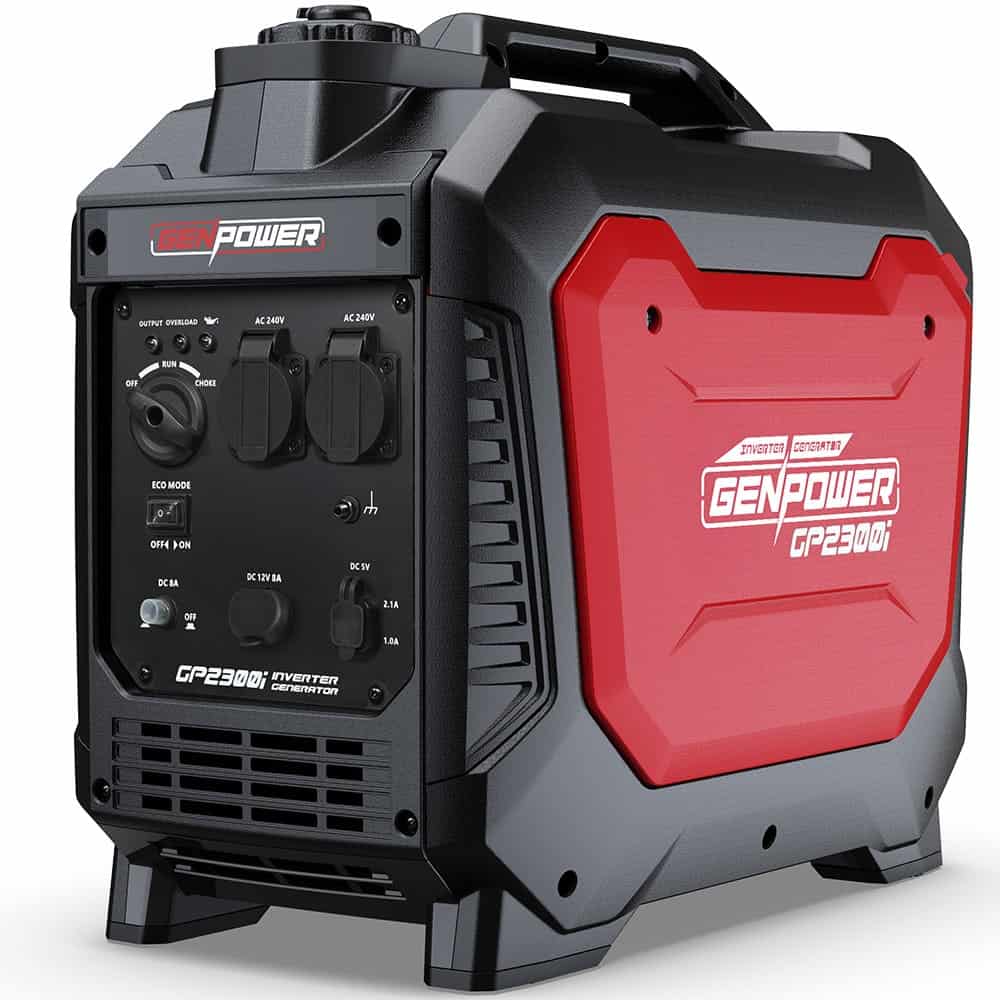
In brief: The petrol-powered GENPOWER GP2300i may suit campers and households needing modest portable power, provided appliance starting loads and outdoor operating requirements are checked first.
The GENPOWER GP2300i is a small petrol inverter generator listed with 1.8kW continuous output and 2.3kW peak output. That makes it worth considering for selected camping appliances or essential items during an outage, rather than whole-home backup.
The most important buying decision is not whether 2.3kW sounds powerful enough. It is whether your appliances can start and run within the generator’s limits, and whether you have a safe place to operate it.
This guide uses the supplied merchant information, not hands-on testing. Noise, runtime, electrical output quality and long-term reliability have not been independently verified.
View the product at Edisons
Check the current specifications, availability, delivery terms and price with the retailer before ordering.
What the supplied specifications tell you
- Model: GENPOWER GP2300i, SKU GENPTRGN23SA.
- Continuous output: 1.8kW, or 1,800 watts.
- Peak output: 2.3kW, or 2,300 watts. The supplied information does not state how long this is available.
- Engine: 80cc OHV petrol engine.
- Connections: the product title lists two 15A outlets, plus 12V and USB outputs.
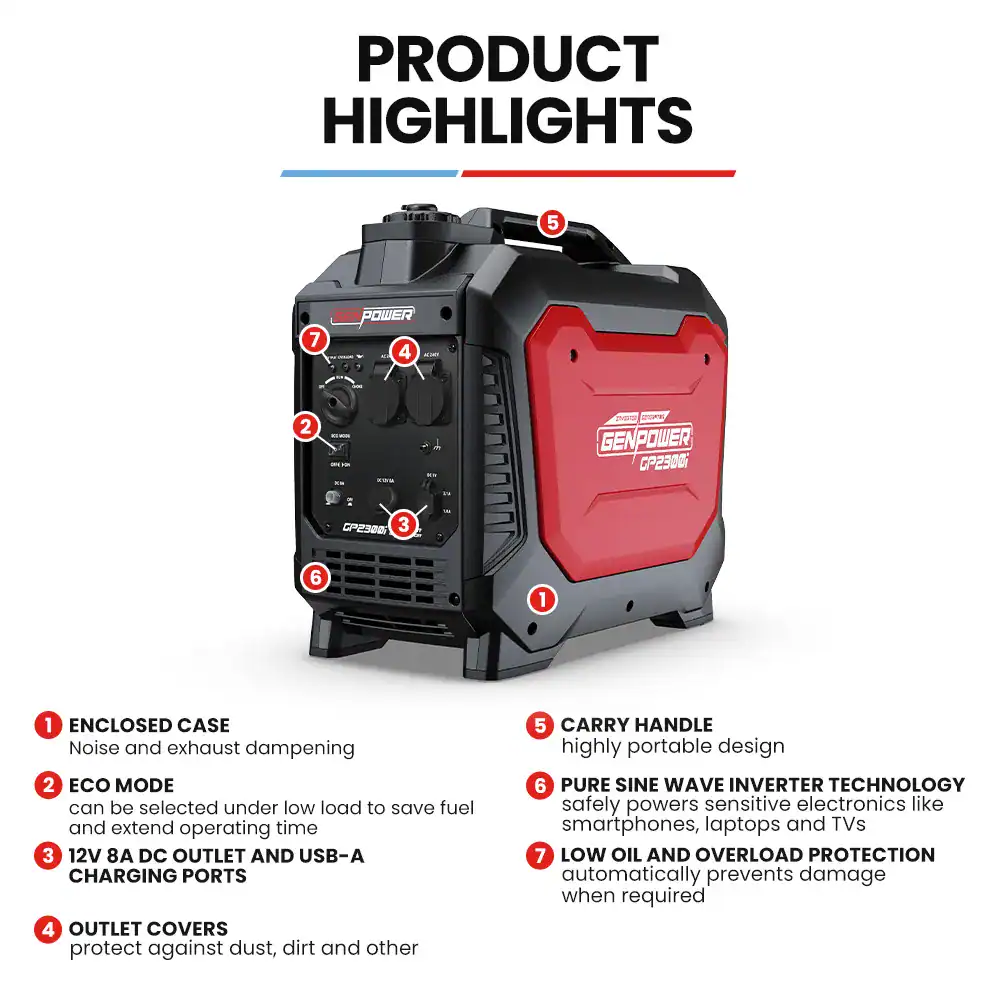
- Other listed features: Eco Mode, an integrated hour meter, a copper-wire alternator and digital AVR.
- Claimed noise: 64dB at 50% load, without a stated measurement distance in the supplied material.
The listing describes the unit as lightweight and compact, but no weight or dimensions were supplied. Tank capacity, runtime, USB ratings and 12V output specifications are also missing. Check the listing and manual before making a decision based on portability or overnight use.
Buy around 1,800 watts, not the peak figure
The continuous rating is the useful starting point for sizing. Add the running watts of everything you plan to use together. Leave headroom rather than building a setup that depends on operating at the limit.
Starting demand is a separate issue. Fridges, pumps, compressors and some power tools can briefly draw much more power than their running labels suggest. A load that runs comfortably below 1,800W may still be difficult to start.
The 2,300W peak rating does not establish compatibility with every appliance below that figure. Peak duration and the appliance’s starting characteristics both matter.
- Write down the appliances you actually need, not everything you might like to use.
- Find their electrical input ratings and, where relevant, starting demand.
- Add the running loads that will operate together.
- Allow for an appliance starting while other equipment is already running.
- Ask the supplier to confirm suitability if starting requirements remain unclear.
For illustration, a hypothetical 1,500W appliance leaves only 300W beneath the continuous rating before allowing any headroom. That is a narrow allowance for other loads.
Two 15A outlets do not mean two separate 15A power supplies. All connected loads share the generator’s total output. Check plug compatibility too; do not modify plugs or use improvised adaptors.
Who this generator may suit
Campers with modest electrical needs
The GP2300i may suit campers running a compatible battery charger, lighting and other low-demand equipment. Its listed USB and 12V connections could be convenient, but their ratings and intended uses need checking.
Do not assume the 12V outlet is a suitable charger for your battery chemistry or battery system. Follow both manufacturers’ instructions and use an appropriate charging arrangement.
Households prioritising a few essentials
For outage planning, think in terms of selected appliances rather than a whole house. A compatible fridge, communications equipment and some lighting may be a practical target, subject to their combined running and starting demand.
It is a poor fit if you expect to run several high-demand heating or cooking appliances together. Do not assume it will start an air conditioner, bore pump or large compressor without checking that specific load.
Occasional tool use
A suitable battery-tool charger or modest corded tool may fall within its capabilities. Motor starting loads still need checking. If you need it for paid work, also confirm site electrical requirements and commercial warranty terms rather than relying on household-use claims.
Noise, fuel use and electronics: read the gaps
The merchant describes the generator as quiet and gives a figure of 64dB at 50% load. Without a measurement distance and fuller test conditions, that number cannot reliably tell you how loud it will seem at your campsite or a neighbour’s property.
Check campground rules before buying. Some sites prohibit generators; others restrict operating hours. A generator marketed for camping is not automatically permitted at your destination.
Eco Mode is a potentially useful feature, but no fuel-consumption or runtime figures were supplied. You cannot calculate fuel needs or overnight operation from the engine size alone. Check tank capacity and runtime at a stated load.
The merchant also claims clean, stable power suitable for sensitive electronics. The supplied information does not include a total harmonic distortion figure or independent electrical testing. Inverter branding, copper windings and digital AVR are not, by themselves, proof of compatibility with every electronic device.
For expensive equipment, seek documented output specifications and check the equipment manufacturer’s advice. Do not make this generator the sole backup plan for critical medical equipment without a suitably qualified backup-power assessment.
Measurements and details to check before buying
Portability matters most when the generator is fuelled and you have to lift it out of a vehicle. Ask for its dry weight, operating weight, dimensions and lifting instructions. Check whether one person can safely handle it in your circumstances.
- Vehicle space: measure the opening and storage position, not just the boot floor. Follow the manual’s transport instructions and secure the unit.
- Operating location: confirm you have an outdoor position with the required clearances, well away from doors, windows and vents.
- Cable route: measure the distance to your appliances. Long leads and unsuitable cable sizes can cause voltage drop and other problems.
- Weather protection: establish how you will keep the equipment dry without restricting ventilation or trapping exhaust.
- Maintenance access: check access to oil filling and draining points, filters and the spark plug.
- Support: confirm access to the manual, servicing, replacement parts and a practical return process.
For a Ballarat winter outage, wet weather is a planning issue, not something to solve after the power fails. A garage is not a safe substitute for a suitable outdoor operating position.
Safe home backup requires more than a generator
Never run a petrol generator indoors, in a garage, under a house, inside a tent or in another enclosed or partly enclosed space. Exhaust contains carbon monoxide, which can kill without warning. An open garage door does not make indoor operation safe.
Operate it outdoors, well away from people and building openings, following the manual’s placement and clearance requirements. Keep exhaust directed away from occupied areas. Carbon monoxide alarms are an extra precaution, not permission to run a generator inside.
Never connect a generator to a household wall socket or use a lead with exposed male pins. Supplying household wiring requires a compliant arrangement designed and installed by a licensed electrician.
For direct appliance use, follow the manual’s requirements for leads, electrical protection and earthing. Do not assume a particular RCD or earth-stake arrangement is suitable; seek qualified advice if unclear.
Switch off and allow the engine to cool before refuelling. Keep fuel in approved containers away from ignition sources. Confirm the required oil, any pre-use setup and service intervals before first use. The hour meter can help track servicing, but it does not replace the maintenance schedule.
View the product at Edisons
Check the current specifications, availability, delivery terms and price with the retailer before ordering.
Limitations, ownership costs and overall fit
The GP2300i’s clearest strengths on paper are its stated 1,800W continuous output, multiple connection types and hour meter. For a carefully selected set of loads, that could make it a useful portable power option.
The main trade-offs are limited simultaneous appliance capacity, petrol storage and servicing, exhaust restrictions and noise. Its suitability is also harder to judge without confirmed weight, runtime, starting capability and fuller electrical specifications.
Budget beyond the purchase price for fuel, oil, suitable leads and maintenance. Household wiring connection costs, if needed, are a separate consideration. Pricing and availability can change; check the current listing.
The supplied description advertises a three-year warranty for non-commercial use and a three-month money-back guarantee. Check the current written terms, exclusions, return costs and commercial-use coverage before relying on either claim.
Bottom line: shortlist it for modest camping loads or selected outage essentials if you can verify appliance compatibility and provide safe outdoor operation. Look for a different power arrangement if you need indoor use, silent operation or broad household coverage.
Frequently asked questions
Will the GP2300i run my fridge?
Possibly, but the fridge’s running wattage alone is not enough to decide. Check compressor starting demand and account for anything else connected. Ask for confirmation against your fridge model if the figures are unavailable.
Can it run a kettle or heater?
Check the appliance’s input rating. Anything above 1,800W exceeds the stated continuous output, even if it is below the peak figure. A high-demand appliance within the limit may leave little capacity for other equipment.
Can it power a caravan through the 15A outlet?
The outlet rating alone does not establish suitability for your caravan setup. Confirm connection and electrical-protection requirements, then check the combined appliance loads. You still have only 1,800W of stated continuous capacity.
Can it run all night?
The supplied data does not establish that. Tank capacity, load-dependent runtime, site rules and safe operating conditions all matter. Plan refuelling around shutting down and cooling the engine; never refuel it while running.
Has this generator been independently tested for this guide?
No. This is a buying guide based on the supplied merchant description and general generator-selection principles. No hands-on testing, noise measurements, runtime trials or reliability assessment were provided.